

As Stella McCartney and H&M announce an “Insights Board” with no garment worker representation and John Galliano is tapped to redesign Zara’s “archives”, we ask: has the clown emoji ever been more appropriate? 🤡
Hey there, one trend we’ve been tracking in recent months is legacy fast fashion brands’ somewhat desperate attempts to convince you that they’re no longer fast fashion.
This week, JD connects the dots in some of our reporting on the topic since December, when we watched H&M tease its new partnership with Stella McCartney. What’s happened since is a bit maddening if you’ve been following the space for a while, as this pivot to mid draws on the same greenwashing playbooks these brands employed a decade ago.
The task for folks who are concerned with this stuff, as we conclude, is to not allow these latest repositioning antics to get in the way of a concerted focus on the injustices in fast fashion’s supply chains and the known solutions.
Thanks to our bosses, our Founding Members, whose support makes this work possible.
JD and Amy
What’s happening
A decade ago, being “mid-market” was risky business, in part due to trends in wealth inequality around the world: the middle class shrunk while the incomes of the wealthiest rapidly rose. As a result, successful fashion brands were either playing to the lower or upper ends of the market, with fast fashion and luxury brands driving all the growth. This was dubbed the “retail apocalypse”, though it wasn’t an even apocalypse; it was the middle of the market collapsing.
It feels kind of silly to read that in the past tense, because none of those fundamental facts of wealth inequality have changed in the decade since. If anything, they’ve only gotten worse. So now in 2026, why are many legacy fast fashion brands repositioning themselves as, ahem, mid-market?
As the BoF-McKinsey State of Fashion report found in January, “almost every brand is moving upmarket,” with “value retailers” like Bershka and H&M reducing the amount of lower-pricepoint items in their UK ranges by as much as 25% between 2023 and 2025. In other words, they’ve tweaked the retail mix toward higher prices, seemingly to move away from that “value” label. Consumers noticing the pinch might not have caught that this is really all about branding and, as yet, seems to have little to do with “sustainability” or quality.
As I wrote in December after watching H&M unveil its collaboration with sustainable luxury’s poster child Stella McCartney at the Fashion Awards, the reasons to reposition as “mid-market” are quite evident:
Ultra fast fashion’s lowering of the floor has created a cynical opportunity for the older-school fast fashion brands to reposition themselves without changing the material realities of their value chains. Take Zara. In November, Bloomberg reported how another fashion billionaire heir, Inditex’s Marta Ortega, was aiming to raise prices and take the brand upmarket — largely to differentiate from the likes of Shein, which had beat Zara at its own cheap game.
And in recent weeks, we’ve only seen more signals that this pivot to mid positioning is largely that: positioning to avoid direct competition with Shein and capture some of those turned off by luxury’s soaring price points. For instance, Zara has recently struck up a partnership with John Galliano, former creative director of Givenchy, Dior and most recently Maison Margiela; he will “re-author” the brand’s “archives.” Saying “archives” is a classic Zara move: using the verbiage of luxury houses to refer to its business model of mimicking the designs of those high-end styles and bringing them to retail in just a few weeks’ turnaround through an exploitative supply chain.
So let’s call it what it is: these brands are in their Ultra Mid Fashion era.
Similar to how ultra fast fashion took everything bad about fast fashion and sped it up, Ultra Mid Fashion takes everything about fast fashion as we’ve known it and goes mid-market and mediocre
Similar to how ultra fast fashion took everything bad about fast fashion and sped it up, Ultra Mid Fashion takes everything about fast fashion as we’ve known it and goes mid (that’s mid-market and also just mid as in… mediocre, boring, seen-this-before).
Legacy fast fashion is colonising the hollowed-out middle from below, but has anything really changed other than the floor?
What people are saying
With Ultra Mid Fashion, brands’ “elevation” is largely just perception, much in the same way as the persistent greenwashing in the 2010s and early 2020s co-opted the language of sustainability without materially changing the underlying take-make-waste business model. In a few cases, the greenwashing is integral to the mid-market pitch.
But even if the fast fashion brands succeed at reframing trend-led business models as something as timeless as an “archive”, and even if they are able to convince customers that Zara is worth XX% more, well, the old patterns haven’t fundamentally changed. (It’s not that parent company Inditex is backing away from the model; it’s aggressively expanding its downmarket retailer Lefties directly to compete with Shein.)
Even if the fast fashion brands succeed at reframing trend-led business models as something as timeless as an “archive”, the old patterns haven’t fundamentally changed.
Consider H&M’s collaboration with McCartney. One core outcome is the Insights Board, which as anxiety.eco reported here in December, would be a platform for “voices from across fashion to create a space for meaningful discussion.” In late March, the brand hit the press circuit hard with the announcement of its Insights Board members and the first London meeting, which, according to the press release, was “focusing on insights.” Now, the lineup included beloved and familiar names such as pop-star Anitta, technologist Kiara Nirghin and editor Susie Lau, among others. But as I wrote before we even saw the lineup: “It’s a lot of talk without any acknowledgement of H&M’s power to actually act on all that discussion.”
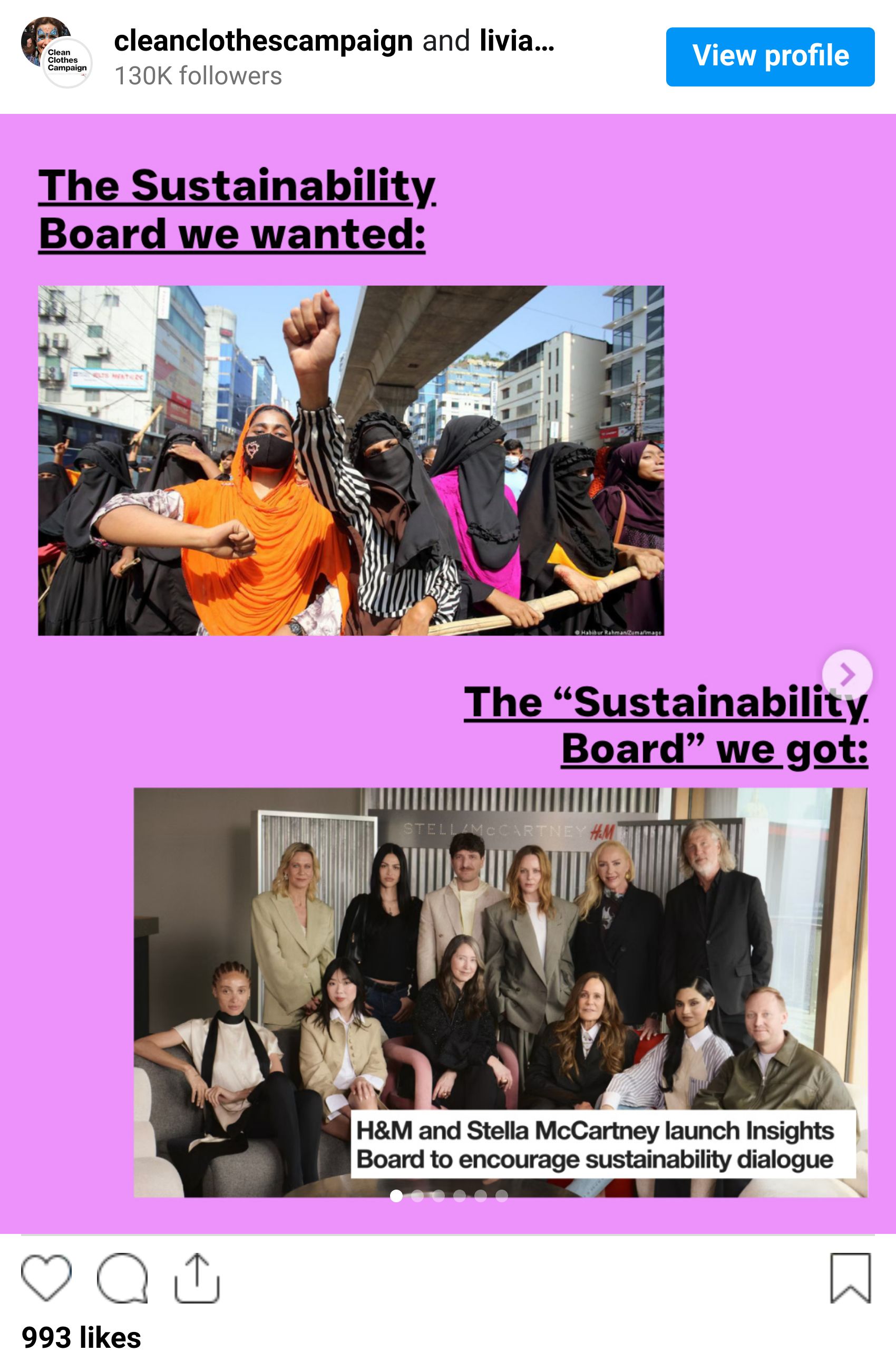
Campaigners immediately jumped on the glaring omission: Clean Clothes Campaign posted on Instagram, posing the questions: “Does that board include the voices of workers who make H&M’s clothes? Workers from climate-vulnerable countries who are at the frontlines of fast-fashion-fuelled ecological crises? Yeah … you guessed it,” followed by a clown-face emoji. “We will let H&M’s recent greenwashing lawsuits, take-back-scheme sham scandals, and the failure to support Bangladeshi garment workers’ demands for dignified wages speak for themselves!”
Livia Giuggioli, who co-founded and ran Eco-Age for more than 16 years, replied: “I am SO tired of this endless BS and greenwashing and I am surprised they get away with it considering it’s been at least 15 years they have been repeating the same crap.”
And perhaps the saddest thing about all of this is H&M is one of a few brands that is at least still showing some engagement in “sustainability.” Its latest sustainability report found the brand had reduced its Scope 3 emissions, by more than a third compared to a 2019 baseline, part of a strategy to decarbonise its supply chain; a great sign of progress few other brands have achieved. “We set our strategy to decouple our financial growth from resource use,” Leyla Ertur, chief sustainability officer for H&M Group, told Bella Webb at Vogue Business in January. There’s a but: “Our strategy is not based on reducing quantities. We would like to produce as much as we can sell.”
Webb addresses the conflict in the next paragraph:
Within this framework, carbon intensity — a valid metric in its own right — becomes a justification of continued growth, which sustainability experts agree is unrealistic at best and catastrophic at worst. Carbon emissions are not the only metric of a product’s sustainability, or lack thereof, and many experts have warned against “carbon tunnel vision”, as it risks discounting issues like water scarcity and pollution, biodiversity loss, and climate resilience.
H&M does not seem to have a serious interest in changing the take-make-waste system at the core of its business.
Ken Pucker, professor of the practice in sustainability at The Fletcher School at Tufts University, posted about the report on LinkedIn, noting it is “[...] light years from anything approximating circular.”
The sustainability positioning that underpins much of the upmarket move remains performative at scale. In other words, it’s mid.
What to keep an eye on
The increasing number of luxury designers entering mass-market brands — Galliano for Zara, McCartney for H&M, Clare Waight Keller for Uniqlo — says as much about the state of luxury fashion more broadly. A sense of stagnation, fatigue with the idea that “luxury fashion is entertainment”, the “greedflation” pushing up the industry’s prices. Luxury’s struggles mean designers like Galliano aren’t necessarily moving to Zara from a position of strength; they might also be hedging bets. After all, falling sales at Stella McCartney have fuelled concerns about the label’s future, which might’ve been what prompted the designer to promote her H&M collaboration by saying consumers need to “embrace sustainability, not run from it.” It’s a sentiment better directed at the fast fashion brands.
Stella McCartney’s statement that consumers need to “embrace sustainability, not run from it,” is a sentiment better directed at fast fashion brands.
But whether a brand wants the fast fashion label or not, the point was never labels at all. It’s power. It doesn’t matter if you call a brand “fast fashion” or “luxury” if its supply chain operates on labour exploitation and human rights violations. Human rights are human rights whether they’re the topic of the Insights Board. The focus needs to remain on specific, tangible areas of improvement.
“Even if a brand manufactures with 100% renewable energy or 100% sustainable materials, that doesn’t make it sustainable, particularly if its volume of production is larger than enough to dress the world three times over,” Ruth MacGilp, fashion campaigns manager at Action Speaks Louder, told me while I was reporting about the satirical dupe brand Mumumelon. Action Speaks Louder and climate creative studio Serious People had created a fake brand, with a pop-up in central London a short walk away from Lululemon’s store, to highlight the need for decarbonising the sector’s supply chain.
Even if a brand manufactures with 100% renewable energy or 100% sustainable materials, that doesn’t make it sustainable, particularly if its volume of production is larger than enough to dress the world three times over
It’s easy, MacGilp says, to be put off by messages brands tell us about how hard it is to significantly improve, and there’s no denying that change can be challenging, “but these are some of the most powerful corporations in the world with billionaire founders, billionaire investors, and they’re telling us it’s too hard,” she says.
“That’s what we’re really trying to hammer home: we should be angry about this and we should push back when they tell us it's not possible. And if it's really not possible, then tell us why. Disclose why, be transparent about why. But use some of that power and some of that revenue and that rapidly growing profit, in Lululemon’s case, to do just a fraction of what we’re asking.”
🔵 You're reading this because you care about who makes your clothes
That's the same reason to care about who makes your journalism.
anxiety.eco is worker-owned and reader-funded. We exist because you decide we should. If you can, join today and lock in 25% off for life.
Launch pricing is 25% off for a limited time:
Founding Member — about £6 a month, roughly the price of a fancy oat milk latte
Lifetime Members — access forever, plus 2 annual memberships to gift
What you get:
No paywalls — full access to everything we publish.
Shape what we make — we’ll invite Founding Members to vote on the perks they want.
Ask us anything — submit questions, we’ll answer them in future issues.
Virtual Founders Forum — a live session where we share what’s coming and take your questions.
The Buy Once List — our regularly updated edit of independent designers
Your name in our public thank-yous — if you want it there, because you help build this.
No ads, ever.
